1.7-billion-year-old islands: the inselbergs of French Guiana's rainforest
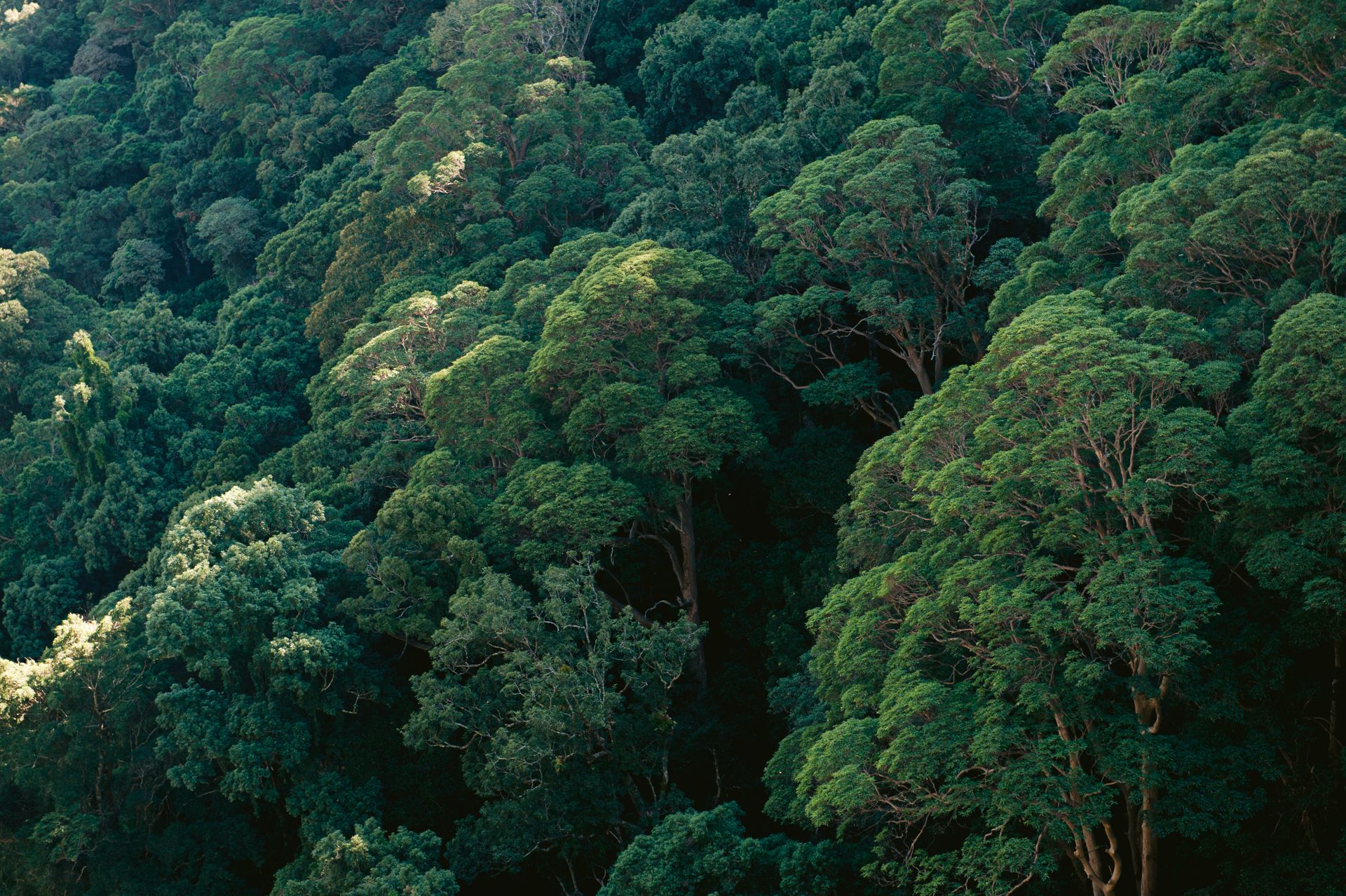
In the southern interior of French Guiana, between Régina and St Georges, more than 200 granite domes rise from the rainforest floor. Known locally as inselbergs (German for "island mountains"), they are remnants of the Guiana Shield, one of the oldest pieces of crust on Earth. They are up to 1.7 billion years old, and their footprint can be traced from Venezuela to the state of Amapá in Brazil.
Inselbergs are the resistant granite cores left behind after billions of years of erosion stripped softer sediments away. They rise between 100 and 800 metres above the surrounding sea-level rainforest, and their bare granite surfaces stand in sharp contrast to the dense forest canopy below. Seen from a distance, they look like rocky islands rising out of a green ocean - the source of the "islands in the jungle" metaphor.
The surfaces of these domes host harsh microclimates. Direct tropical sunlight, extreme temperature swings (from over 50 degrees by day to 18 degrees by night) and long droughts make the granite surface an extreme biotope. Yet life persists. Mosses, lichens and xerophytic plants colonise the cracks; in rainy periods, transient pools form on the surface. This microecosystem differs fundamentally from the rainforest 50 metres away.
Access to the inselbergs has, until recently, been a serious obstacle. Before a road was opened between Régina and St Georges in 2003, the domes could only be reached by long, arduous boat trips or by helicopter. That severely limited scientific work, and even now no comprehensive species inventory has been made of all the inselbergs. A 2024 report by France's National Museum of Natural History stated that at least 47 inselbergs have not yet been studied in detail by any scientific team.
Each dome carries its own micro-floral signature. On the Inselberg de Nouragues, one of the larger domes studied since the 1990s, three orchid species and more than ten lichen types found nowhere else have been documented. Several animal species are endemic to these islands, from small rodents to larger predators. Inselbergs often function as semi-closed ecosystems, because the surrounding forest gap is a barrier that many small creatures find difficult to cross.
The French National Centre for Scientific Research (CNRS) has run a permanent research station on the Inselberg de Nouragues since 2008. The station hosts researchers throughout the year and has formed the basis of 32 doctoral theses. Studies in botany, geology, climate, ethology and evolutionary biology have helped scientists understand how inselberg bird and insect communities evolve.
Climate change threatens these microecosystems. CNRS's 2025 report documents that dry periods on inselberg surfaces have lengthened by an average of 12 days over the past 30 years, and that prolonged drought has left some endemic plant species withered. Surface temperatures occasionally reach 65 degrees in summer, irreversibly damaging some textures of the granite surface.
Atlas Obscura writer Charlotte Rey described her impression on a 2025 visit: "As you climb up from the forest floor, the trees suddenly end and bare granite appears under your feet. Looking up, the dome under the cloudless blue sky has been completely cut off from the surrounding rainforest, as if it belongs to another planet." Inselberg visits are at present possible only by guided expedition; independent excursions are not banned, but the geography is too challenging.
France established national-park status for the inselberg ecosystem in 2007. The Parc Amazonien de Guyane is, at 33,900 square kilometres, the largest national park in France. There are 35 large inselbergs within the park. The park administration tries to keep the area open to biological research while limiting tourism pressure; annual visitor limits per major inselberg are kept at 200 people.
Scientifically, inselbergs are tangible evidence of geological time. A rock that has stood here for 1.7 billion years equals roughly a third of the age of the Earth. These domes have witnessed everything from the Atlanta-Vermont glacial cycles to the rise of dinosaurs and the existence of humankind, and they still rise from the rainforest floor today. As access to French Guiana from the European Union does not require a Schengen visa, the international scientific community's access to these domes is expanding year on year.