The Hessians were meant to crush the American Revolution fast. They fought for years instead
When British forces began arriving in North America in 1776 to suppress the colonial rebellion, they brought with them a substantial and often misunderstood auxiliary force: roughly 30,000 German soldiers, popularly remembered in American history simply as "Hessians." The name has stuck for two and a half centuries, but it obscures a more complicated reality — not all of these soldiers came from Hesse, and describing them as mercenaries, in the sense of individual soldiers of fortune selling their services, misrepresents how they came to fight in America at all.
The soldiers were supplied not through individual recruitment for pay, but through formal treaties between the British crown and the rulers of several German principalities, most prominently Hesse-Kassel, but also Hesse-Hanau, Brunswick, Ansbach-Bayreuth, Waldeck and Anhalt-Zerbst. Under these agreements, German princes rented out entire regiments of their standing armies to Britain in exchange for substantial payments, a practice with deep roots in European military tradition, where smaller states routinely supplemented their treasuries by leasing troops to larger powers engaged in conflicts elsewhere on the continent.
For the individual soldiers themselves, service was rarely voluntary in any meaningful sense. Many were conscripted directly into their prince's standing army through systems of compulsory military service that gave ordinary subjects little say in where or for whom they fought. Once assigned to a regiment contracted out to Britain, a soldier had no more choice in crossing the Atlantic to fight in an unfamiliar war than he would have had in any other deployment ordered by his sovereign. This distinction — between rented regiments of conscripted subjects and individually contracted mercenaries — is central to how historians now understand the Hessian experience, even though American revolutionary propaganda at the time, and popular memory since, has consistently blurred the two.
Britain's decision to hire German troops stemmed from practical necessity. The British army was relatively small by continental standards and had committed forces to garrisons and conflicts across a global empire, leaving insufficient manpower to suppress a rebellion spread across thirteen colonies along a long and logistically difficult coastline. German principalities, particularly Hesse-Kassel under Landgrave Frederick II, maintained well-trained, well-equipped standing armies that could be deployed relatively quickly once treaty terms were agreed, offering Britain a faster path to reinforcement than expanding recruitment within Britain itself.
The Hessians and their fellow German auxiliaries arrived expecting, as did much of the British leadership, that the rebellion would be crushed relatively swiftly. Instead, they found themselves engaged in a war that dragged on for the better part of a decade, fighting in major engagements from the Battle of Long Island in 1776 through the war's final campaigns in the early 1780s. Their most consequential and best remembered engagement came at the Battle of Trenton on December 26, 1776, when George Washington's surprise crossing of the icy Delaware River caught a garrison of roughly 1,500 Hessian troops off guard, resulting in a decisive American victory that significantly boosted revolutionary morale at a critical low point in the war.
Contrary to a persistent stereotype in American popular memory, portraying the Hessians as brutal or especially fearsome soldiers, historical accounts from the period generally describe them as disciplined, professionally trained troops who conducted themselves within the conventions of eighteenth-century European warfare, no more or less harshly than British regulars or, for that matter, American Continental soldiers. Their reputation for severity in American revolutionary propaganda served a specific political purpose: casting the war as a fight against foreign tyranny reinforced by imported mercenaries strengthened the moral case for independence and helped rally colonial support against what was framed as an illegitimate use of hired foreign troops against fellow subjects of the crown.
Casualties among the German auxiliary forces over the course of the war were substantial. Historians estimate that of the roughly 30,000 German soldiers who served, several thousand died from combat, disease and the harsh conditions of campaigning in an unfamiliar climate, while a significant additional number simply chose not to return home after the war ended, deserting or settling permanently in the newly independent United States, drawn by the prospect of land ownership and a fresh start unavailable to them in the rigid social hierarchies of their German principalities.
That pattern of postwar settlement left a lasting demographic and cultural footprint. Communities of German-American descent tracing their origins to former Hessian soldiers persist across the mid-Atlantic and parts of the American South, and the broader wave of German immigration to America in the decades following the Revolution built on cultural and family connections that, in some cases, originated with soldiers who had first arrived in America not as immigrants but as conscripted combatants sent to suppress the very nation many of their descendants would help build.
Historians studying the Hessian experience emphasize that understanding these soldiers on their own terms — as conscripted subjects fulfilling obligations imposed by their rulers rather than mercenaries who chose to fight for money — reframes a piece of Revolutionary War history that has often been reduced to caricature. Their story sits at an intersection of eighteenth-century European statecraft, in which rulers routinely treated soldiers as a commodity to be rented out for revenue, and the American revolutionary narrative, which needed a clear foreign villain to sharpen the moral clarity of its cause.
Today, the Hessian regiments occupy a peculiar place in American historical memory: instantly recognizable by name, frequently invoked in popular retellings of the Revolution, and yet still widely misunderstood in terms of who these soldiers actually were, why they fought, and what became of the many who, having been sent to crush a rebellion, ultimately stayed to become part of the nation it created.
Read next

Fannie Bay Gaol: the frontier prison that held Australia's Northern Territory for nearly a century
For nearly a hundred years, Fannie Bay Gaol served as the principal prison of Australia's Northern Territory, holding everyone from cattle rustlers to condemned murderers behind walls built from local stone, timber and corrugated iron. Its gallows carried out the territory's last executions before the prison closed in 1979, leaving behind one of Australia's most complete surviving frontier penal sites.

On this day in 1914: the Panama Canal opened, rewriting the map of global trade
On August 15, 1914, the cargo ship SS Ancon made the first official transit of the Panama Canal, completing a decade-long construction project that let ships cross between the Atlantic and Pacific without sailing around South America. The canal remains one of the most consequential engineering projects in modern history.

Who was Yuri Gagarin? The story of the first human in space
In 1961, Yuri Gagarin orbited the Earth once aboard the Vostok 1 capsule, becoming the first human being to venture into space. Born to a peasant family, his journey from rural Russia to global icon became one of the defining symbols of the Cold War era.
On this day: the US Social Security Act is signed into law (1935)
On 14 August 1935, President Franklin D. Roosevelt signed the Social Security Act into law amid the Great Depression, establishing a federal system of old-age, unemployment and disability insurance in the United States. The act became one of the most influential blueprints for the modern welfare state worldwide.
Olaf Tryggvason: the Viking king whose death is still a mystery
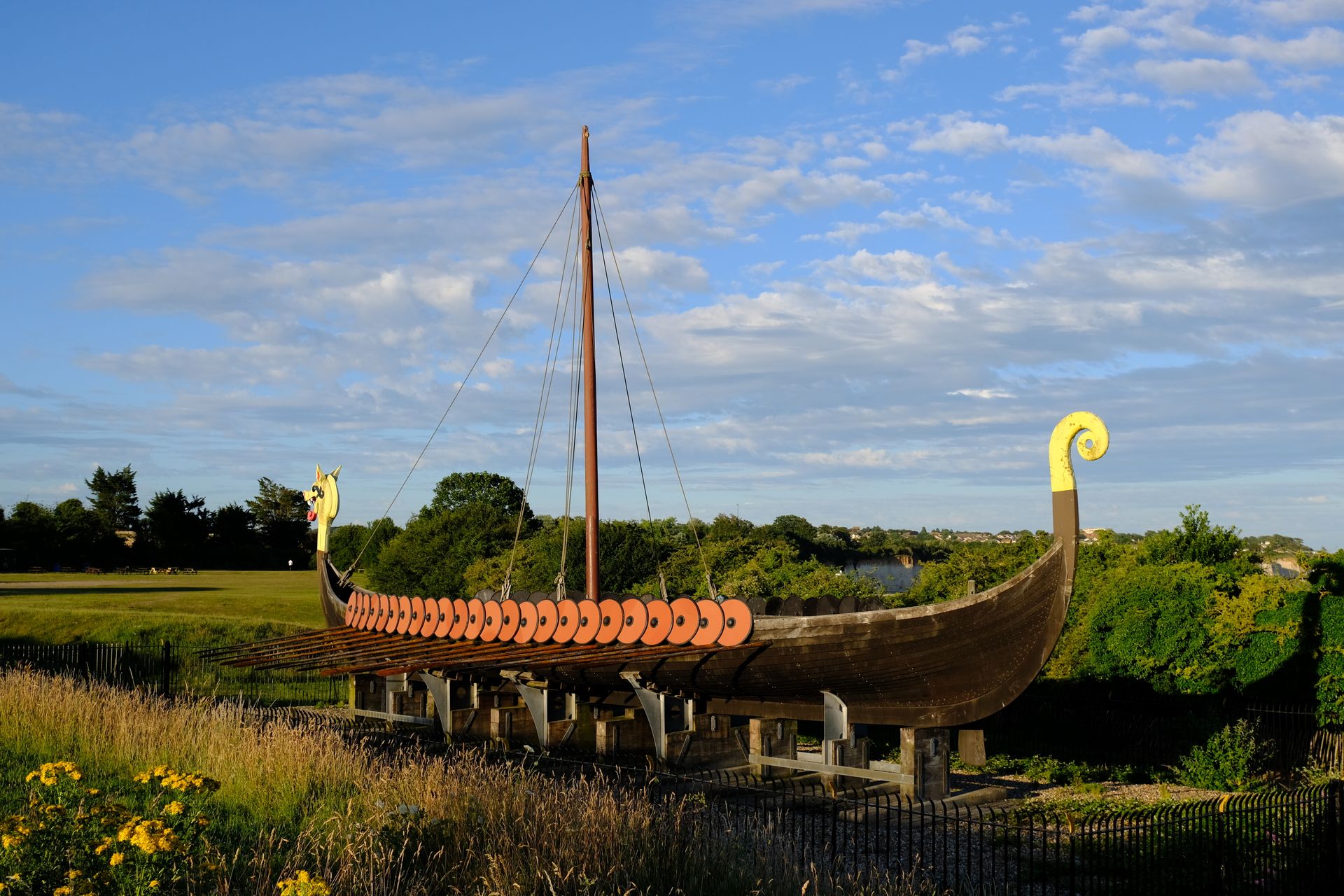
King Olaf Tryggvason of Norway vanished at the Battle of Svolder around AD 1000, in one of the most dramatic episodes of the Viking Age. Most medieval sources say he drowned in his armor rather than surrender, but some later accounts — and a handful of modern historians — have wondered whether he actually escaped.